How to Choose a Pump for Viscous Liquids
A practical guide to selecting rotary positive displacement pumps for viscous and non-Newtonian liquids: pump type, slip, suction, pressure relief, seals and data sheets.

Viscous liquids change the pump selection problem. A pump that transfers water efficiently can lose capacity, run out of motor torque, starve at the suction side or damage its seal when the liquid becomes cold, thick or shear-sensitive. For oils, syrups, polymers, slurries and pastes, a rotary positive displacement pump is often the starting point because it moves a defined volume every revolution. The final selection still depends on the actual liquid, the piping system and the operating envelope.
Start with the liquid at the worst operating condition
Ask for viscosity at the lowest pumping temperature, not a catalogue value at room temperature. Record whether the value is dynamic viscosity in mPa·s or cP, or kinematic viscosity in cSt. They are related by density: kinematic viscosity equals dynamic viscosity divided by density in g/cm³. A value without temperature, test method and shear rate is not enough for a reliable selection.
Also establish whether the liquid is Newtonian. Heavy fuel oil is often close enough to Newtonian for a conventional viscosity curve. Food pastes, coatings, gels and polymer solutions can be shear-thinning, thixotropic or yield-stress materials. Their apparent viscosity can fall in the pump, hose or valve as shear increases, then recover at rest. A single cP value can therefore understate the starting torque and overstate the running pressure drop.
- Temperature range: minimum, normal and maximum liquid temperature at the pump inlet.
- Rheology: Newtonian, shear-thinning, thixotropic or yield-stress behaviour; provide a viscosity-versus-shear-rate curve when available.
- Density and vapour pressure: required for suction calculations and motor sizing.
- Solids and fibres: concentration, maximum size, hardness and whether particles are fragile.
- Gas: entrained air, dissolved gas and the likelihood of intermittent dry running.
Match the positive displacement principle to the liquid
Positive displacement pumps are not one category. Their flow is primarily set by displacement and speed, while pressure is created by the system resistance. Select the geometry for the product and service duty instead of selecting by viscosity alone.

Gear and screw pumps
External or internal gear pumps suit clean, lubricating oils, resins and fuels. Twin, triple and multi-screw pumps offer low pulsation and can be a strong choice for lubricating liquids where continuous flow matters. Fine clearances help efficiency but make these designs less tolerant of hard solids and dry running. Confirm the permitted differential pressure, viscosity range, shaft speed and the manufacturer limits for the actual model.
Lobe, circumferential piston and flexible impeller pumps
Rotary lobe and circumferential piston pumps are commonly chosen where cleanability, gentle handling or larger soft solids matter. Their clearances and speed must be selected for the viscosity and temperature range; high viscosity can raise torque rapidly, while low viscosity can increase slip. Flexible impeller pumps can handle moderate viscosities and intermittent solids in suitable services, but the elastomer, temperature and dry-run limit need careful review.
Progressive cavity and peristaltic pumps
Progressive cavity pumps are useful for very viscous, abrasive, fibrous or shear-sensitive products. They can develop high pressure in stages, so rotor-stator compatibility, speed, temperature rise and dry-run protection are central to the selection. Peristaltic pumps isolate the liquid in a hose and tolerate abrasive slurries well, but hose life, pressure capability, pulsation and the replacement interval must be part of the operating cost calculation.
Size capacity with speed and slip, not nameplate flow alone
A first estimate is theoretical flow: displacement per revolution multiplied by speed. Actual flow is lower because a small amount of liquid returns through internal clearances as differential pressure rises. This is called slip. Higher viscosity can reduce slip, but it also increases friction, inlet loss and torque. Low-viscosity operation can be the limiting case for volumetric efficiency; cold high-viscosity operation can be the limiting case for motor and gearbox torque.
Give the supplier minimum, normal and maximum flow, each paired with the expected differential pressure and operating hours. Ask for delivered flow, shaft power and torque at every point. Do not assume that a pump rated for a maximum pressure can run continuously there at the selected speed and temperature.
- Define the required flow range, including start-up, normal and cleaning or flushing cases.
- Calculate differential pressure from the complete system: static head, pipe friction, filters, heat exchangers, meters, valves and discharge pressure.
- Use viscosity at the coldest credible pump-inlet temperature for torque and suction checks.
- Choose displacement so normal flow occurs in the preferred speed range, leaving adjustment room without operating too slowly or too fast.
- Obtain the vendor curve or calculation for actual capacity, power, torque, inlet requirement and allowable pressure at each duty point.
Treat overpressure protection as part of the pump system
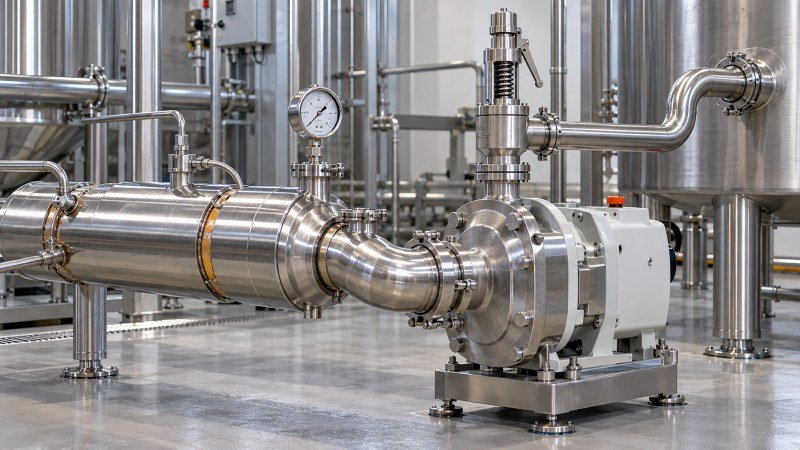
A positive displacement pump will continue to displace liquid when its discharge valve is closed. Pressure can rise rapidly until something yields. Every installation needs a properly sized overpressure protection path that cannot be isolated from the pump discharge. Depending on the duty, this may be an integral relief valve, an external relief valve or a controlled bypass returning to a tank or suction vessel. The relief route must safely accept the full pump capacity and the returned liquid must not overheat.
A relief valve is not a flow-control valve. Continuous bypassing wastes energy, heats a viscous liquid and can shorten seal, bearing or elastomer life. If flow varies widely, use speed control, a recirculation arrangement designed for the heat load, or a pump sized for the actual operating envelope.
Protect the suction side
Viscous liquids create high inlet losses. Keep the suction line short, generously sized and free of unnecessary restrictions. Put strainers, filters and heat exchangers in the calculation at their fouled condition. Use eccentric reducers in horizontal lines where air can collect, avoid high points that trap gas, and locate the pump below liquid level where the process allows it.
NPSH terminology is most often used for rotodynamic pumps, but the suction problem does not disappear with a positive displacement pump. The supplier should state the required inlet pressure or allowable inlet depression at the selected speed and viscosity. Verify the absolute pressure at the pump inlet at minimum tank level, cold liquid temperature and maximum flow. If the liquid needs heating, heat the tank, jacketed lines and pump casing consistently; a hot jacket on a cold suction line does not solve a cold plug upstream.
Select drive, seal and materials for real start-up conditions
Motor power alone is not enough. The drive train must supply starting and running torque through the gearbox, coupling and variable-speed drive. Specify the cold-start viscosity, any period of blocked or slow rotation, and the maximum differential pressure. A VFD gives useful flow adjustment, but respect the minimum speed needed for lubrication, cooling and stable product transfer.
Choose seal faces, elastomers and casing materials for temperature, chemical compatibility and solids. A single mechanical seal can work well for clean lubricating liquids; double seals, flush plans, packed glands, sealless arrangements or hygienic designs may be appropriate in other services. For viscous products, a seal flush plan must be compatible with the process: an unsuitable flush can dilute, solidify or contaminate the product.
Worked selection logic: cold polymer solution
Consider a polymer solution transferred from a day tank at 4 m³/h. At 20 °C it is 8,000 mPa·s, but at the cold start temperature of 10 °C it reaches 25,000 mPa·s and is shear-thinning. The process needs 5 bar differential pressure at normal filter condition and may reach 7 bar at a fouled filter. A centrifugal pump selected on the warm viscosity is a poor baseline because its water curve no longer represents the duty.
A progressive cavity or low-speed lobe pump becomes a reasonable shortlist. The next questions decide between them: allowable shear, solids, clean-in-place requirement, dry-run exposure, required flow stability, maintenance access and seal arrangement. Request a vendor calculation at 25,000 mPa·s and 7 bar, with inlet conditions, starting torque, motor and gearbox service factor, stator or elastomer temperature limit, and the relief-valve set point. The selection is complete only when those values, the piping pressure drop and the control method agree.
Data sheet checklist for a supplier enquiry
- Liquid name, concentration, density, vapour pressure, viscosity with temperature and shear-rate information.
- Flow and differential-pressure range for every operating case, plus annual operating hours.
- Suction vessel pressure and level range; suction-line size, length, fittings, filter and heat-exchanger losses.
- Solids, fibres, gas content, dry-run risk and cleaning or flushing requirements.
- Minimum and maximum ambient and liquid temperatures; insulation, jacket or trace-heating requirements.
- Materials, seal or packing preference, hazardous-area classification and applicable process standards.
- Power supply, drive preference, control range, allowable pulsation and required relief or bypass arrangement.
- Requested acceptance information: capacity, differential pressure, power, torque, inlet requirement, speed and test-liquid basis.
Sources and further reading
- Hydraulic Institute: Pump FAQs and Fluid Viscosity for Pump Systems.
- Hydraulic Institute: How Viscosity Affects Pumping.
- API: API Std 676 listing for rotary positive displacement pumps.
- KSB: Positive displacement pump overview.
Use this guide to prepare a technically complete enquiry. The pump manufacturer remains responsible for confirming the selected model and limits for the specific liquid and installation.